
The 25% (or 33%) Subordination Test for 401(h) Funding
Understanding the 25% subordination test is crucial for maximizing your 401(h) plan contributions. This guide breaks down the rules for employers and employees.
Contents
What is a 401(h) Plan?
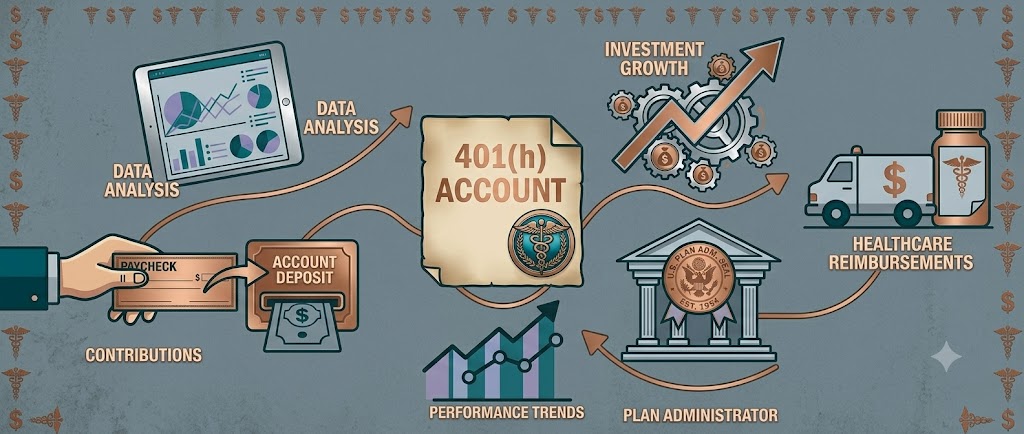
A 401(h) account is a special account linked to a pension plan. It is designed to help retirees cover healthcare expenses. It offers a unique way for employers to provide tax-advantaged healthcare benefits alongside traditional pension income. Contributions to a 401(h) are tax-deductible for the employer, and distributions for qualified medical expenses are tax-free for the retiree.
The primary appeal of a 401(h) account lies in its highly favored "triple-tax-free" status under the Internal Revenue Code, operating much like a supercharged Health Savings Account (HSA) but without the requirement of a high-deductible health plan. Employer contributions to the account are fully tax-deductible for the business in the year they are made. As the investments within the sub-account grow, they do so entirely shielded from taxation.
When the funds are distributed during retirement to pay for or reimburse qualified medical expenses—such as Medicare premiums, supplemental insurance, and out-of-pocket costs—those distributions are completely tax-free to the retiree.
IRS Regulation
To prevent the abuse of this favorable tax treatment, the IRS enforces strict operational guardrails, most notably the "subordination" requirement. The law mandates that the medical benefits provided must remain subordinate to the primary retirement income benefits of the pension plan. In practical terms, this means that the cumulative contributions made to the 401(h) account cannot exceed 25% of the total actual contributions made to the overall plan (excluding contributions for past service credits) since the medical account was formally established.
Funding a 401(h) account is heavily regulated and cannot be based on discretionary cash deposits aimed simply at maximizing current-year business tax deductions. Contributions must be justified by reasonable, actuarially determined estimates of future medical liabilities for the covered participants.
Furthermore, while 401(h) allocations are uniquely exempt from the standard 100%-of-compensation limit, they are still strictly classified as "annual additions" under Section 415(c). Therefore, the 401(h) funding, when aggregated with any other defined contribution allocations for a participant, cannot exceed the hard statutory dollar limit set by the IRS for that given year.
Administratively, the assets within a 401(h) account must be strictly ring-fenced from the rest of the pension plan's assets. While the funds can legally be pooled with the general pension assets for investment purposes to achieve economies of scale, the plan administrator must maintain meticulous separate internal accounting.
It must be impossible for the 401(h) funds to be diverted to pay for regular retirement pensions, and conversely, standard pension assets cannot be used to pay for retiree medical benefits. Once all retiree medical liabilities have been permanently satisfied, any excess funds remaining in the 401(h) account cannot be distributed to participants and must be returned to the employer.
Understanding the 25% Subordination Test
The 25% subordination test is a critical rule that governs how much an employer can contribute to a 401(h) account. It dictates that the aggregate amount contributed to a 401(h) for retiree medical benefits, when added to amounts for life insurance protection, cannot exceed 25% of the total aggregate contributions made to the defined benefit plan since the 401(h) account was established. This isn't a per-year limit, but rather a cumulative test over the life of the plan.
Meeting this test is paramount for maintaining the tax-qualified status of both the 401(h) and the larger defined benefit plan. Failing the 25% subordination test can have significant tax consequences, including the potential disqualification of the plan.
The 25% Subordination Test mandates that contributions for 401(h) medical benefits cannot exceed one-quarter of the total contributions made to the employer's profit-sharing or stock bonus plan for all other benefits since the 401(h) account was established. This ensures that the primary purpose of the plan remains retirement savings, with medical benefits playing a subordinate role.
The 33% Funding Rule: A Different Limit
While often discussed alongside the subordination test, the '33% funding rule' addresses a separate, though related, aspect of 401(h) funding. This rule primarily applies to the transfer of excess assets from a defined benefit plan to a 401(h) account.
If a defined benefit plan is overfunded, a portion of those excess assets (up to 33% of the amount transferred to the 401(h) in certain situations, or 33% of the total plan contribution in others) can potentially be used to fund the 401(h) account, provided other conditions are met. This rule often pertains to specific instances of asset reallocation rather than ongoing contributions.
Maximizing Your 401(h) Contributions
Navigating the 25% subordination test and other related funding rules requires careful planning and a deep understanding of your defined benefit plan structure. For small business owners, doctors, and high-income earners, strategically utilizing a 401(h) can create a substantial tax-advantaged pool for future healthcare costs, especially as healthcare expenses continue to rise in retirement.
Working with experienced professionals, such as actuaries and tax advisors, is crucial. They can help you project funding limits accurately, ensure compliance with IRS regulations, and optimize your contributions to secure significant future tax-free benefits.
- Understand your defined benefit plan's funding status.
- Work with an actuary to project 401(h) contribution limits.
- Regularly review plan contributions against the 25% subordination test.
- Consider the implications of the 33% funding rule for asset transfers.
- Explore all available mechanisms to fund your 401(h) within IRS guidelines.
Bottom Line
If you remember nothing else from this article, remember this: the subordination test exists to keep the medical account in its proper place — a generous passenger, never the driver. The retirement plan does the heavy lifting, and the 401(h) rides along at up to 25% of the total contributions flowing into the plan.
And here's the framing that clears up most of the confusion around the "25% versus 33%" question. They're two ways of expressing the same relationship. Medical contributions capped at 25% of the combined total is the same thing as medical contributions capped at one-third of the retirement contributions.
The practical implications are simple. Because the test is cumulative rather than annual, your funding history matters — years of strong retirement contributions build capacity for the medical account over time. Because the medical funding scales with retirement funding, the surest way to enlarge the 401(h) is to enlarge the host plan.
None of this is a reason to shy away from the account. The subordination test isn't a trap. It's the price of admission for a benefit the tax law treats extraordinarily well — deductible going in, tax-free while it grows, and tax-free coming out for retirement medical expenses.
Frequently asked questions
Availability, tax treatment, and plan design depend on the facts and circumstances of the employer, plan document, participant group, and applicable law. 401h.com provides general educational information only — not tax, legal, actuarial, investment, or ERISA advice. Consult qualified tax, legal, actuarial, and plan professionals.
401h.com Editorial
401h.com
The 401h.com editorial team publishes plain-English explainers on 401(h) retiree medical benefit plans. Educational only — not tax, legal, actuarial, investment, or ERISA advice.
Related articles
Can You Use a 401(h) Account to Fund Long-Term Care Insurance?
A 401(h) account can generally be used to help fund long-term care insurance. But it comes with strings that most other medical expenses don't.
401(k) vs Money Purchase Plan: A Simple Comparison
But the money purchase plan isn't quite extinct, because it qualifies as a pension. And that single trait gives it a modern purpose: acting as the pension that a retiree medical account needs in order to exist.
Can a 401(h) Account Pay for Dental Expenses?
Done correctly, this is one of the cleanest deals in the code. The employer deducts the contribution to the 401(h) account. The account grows tax-free inside the trust. The reimbursement to the retiree for the dental expense comes out tax-free.