
401(k) vs Money Purchase Plan: A Simple Comparison
But the money purchase plan isn't quite extinct, because it qualifies as a pension. And that single trait gives it a modern purpose: acting as the pension that a retiree medical account needs in order to exist.
Contents
Introduction
If you're a business owner weighing retirement plan options, you'll eventually run into two names that sound like they might do the same thing: the 401(k) plan and the money purchase plan. They're cousins — but they are not equals. For almost everyone, one of them is clearly the better choice, and the other survives for one narrow, specific reason.
Here's the plain-English version of how they compare, and when the underdog actually earns its keep.
First, what they have in common
Both the 401(k) and the money purchase plan belong to the same family: they're defined contribution plans.
That phrase just means the plan is built around what goes in, not what comes out. Money is contributed to an individual account each year, that account gets invested, and whatever it grows to is what you'll have in retirement. There's no promise of a specific monthly check down the road — your future balance simply depends on the contributions and how the investments perform. Both plans work this way, which is why they feel similar at a glance.
They also share the same basic plumbing: individual accounts, tax-deferred growth, familiar investment options, and the usual rules about waiting until retirement age to take the money out without penalty.
And here's a point that trips people up: you're allowed to have both plans at the same time. They aren't an either/or in the eyes of the rules. A business can run a 401(k) and a money purchase plan side by side, and that combination is actually the key to the one situation where the money purchase plan shines — more on that shortly.
Why the 401(k) usually wins
For most businesses, the 401(k) is simply the better tool. It comes down to flexibility and to a feature the money purchase plan doesn't have at all.
The 401(k) lets employees contribute their own money. This is the employee deferral — the part of your paycheck you choose to set aside before taxes. It's the heart of what makes a 401(k) so popular, and it's entirely under each employee's control. Want to save more this year? Turn the dial up. Need to ease off? Turn it down. A money purchase plan has nothing like this. All the money in a money purchase plan comes from the employer.
The 401(k) can also include profit sharing. On top of what employees put in themselves, the employer can add a profit-sharing contribution — an extra amount the company chooses to give. And the magic word there is chooses. Profit sharing is flexible: in a strong year the business can contribute generously, and in a lean year it can contribute little or nothing.
Put those two pieces together — employee deferrals plus flexible profit sharing — and the 401(k) gives you two ways to fund retirement and a lot of room to adjust year to year. That combination is why the 401(k) is the default choice for the overwhelming majority of businesses.
So why does the money purchase plan still exist?
Here's the catch that defines the money purchase plan: its contributions are mandatory.
When you set up a money purchase plan, you commit to a fixed contribution formula, and the business has to fund it every single year — good year or bad. There's no dialing it down when cash is tight. That rigidity is exactly why the money purchase plan fell out of favor. The 401(k) with profit sharing can do most of what a money purchase plan does, but with the freedom to adjust. Given the choice, most businesses take the flexibility.
So for years, the money purchase plan looked like a relic. But it has one quality that turns out to be quietly valuable: in the eyes of the rules, a money purchase plan counts as a pension.
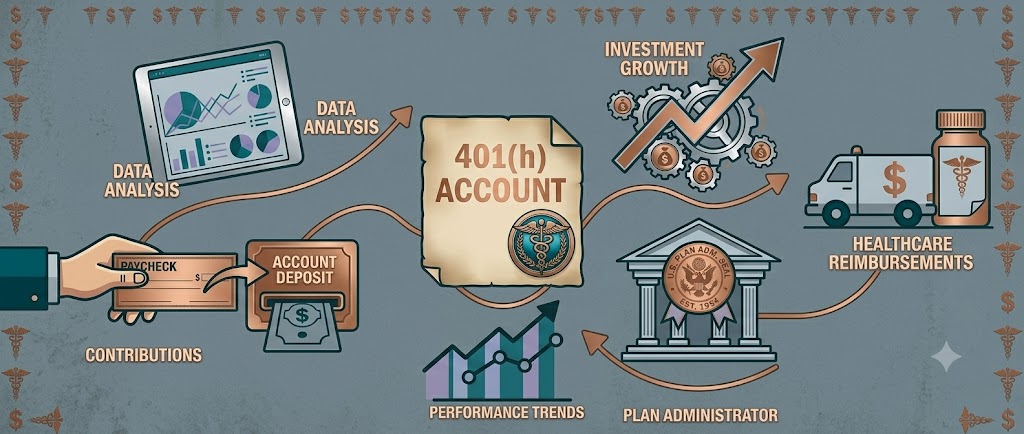
That word matters more than it sounds. Certain advanced strategies require a pension plan specifically — a regular 401(k) or profit-sharing plan won't qualify. The most important example is a special retiree medical account (often called a 401(h) account) that lets a business set aside money to pay for healthcare costs in retirement, with attractive tax treatment. That kind of account can only attach to a pension plan. A 401(k) by itself can't host one.
This is where the money purchase plan earns its keep. If a business wants that retiree medical account but doesn't otherwise have a pension in place, a money purchase plan can serve as the host — the pension "shell" that the medical account attaches to. Run it alongside the 401(k), and you get the best of both: the flexibility of the 401(k) for the bulk of the retirement saving, and the money purchase plan sitting quietly beside it, doing the one job only a pension can do.
Put simply: on its own, a money purchase plan rarely makes sense today. Its main reason to exist is to serve as the pension that a retiree medical account can hang onto.
The bottom line
For everyday retirement saving, the 401(k) is the stronger, more flexible plan. It lets employees contribute their own money through deferrals, it lets the employer add profit sharing on top, and it gives everyone the freedom to adjust contributions as circumstances change. A money purchase plan, by contrast, locks the business into a mandatory contribution every year — which is why, as a standalone plan, it's largely faded from use.
But the money purchase plan isn't quite extinct, because it qualifies as a pension. That single trait gives it a modern purpose: acting as the pension that a retiree medical account needs in order to exist. Paired with a 401(k), it can quietly unlock a powerful way to fund healthcare in retirement that a 401(k) alone simply can't reach.
Availability, tax treatment, and plan design depend on the facts and circumstances of the employer, plan document, participant group, and applicable law. 401h.com provides general educational information only — not tax, legal, actuarial, investment, or ERISA advice. Consult qualified tax, legal, actuarial, and plan professionals.
401h.com Editorial
401h.com
The 401h.com editorial team publishes plain-English explainers on 401(h) retiree medical benefit plans. Educational only — not tax, legal, actuarial, investment, or ERISA advice.
Related articles
Can You Use a 401(h) Account to Fund Long-Term Care Insurance?
A 401(h) account can generally be used to help fund long-term care insurance. But it comes with strings that most other medical expenses don't.
Can a 401(h) Account Pay for Dental Expenses?
Done correctly, this is one of the cleanest deals in the code. The employer deducts the contribution to the 401(h) account. The account grows tax-free inside the trust. The reimbursement to the retiree for the dental expense comes out tax-free.
Can You Tap a 401(h) Account While Still Working? What the IRS Said About Age 59½