
Can a Cash Balance Plan Include a 401(h) Account?
Cash balance plans, while appearing like individual accounts, are classified as defined benefit plans under IRS rules. This crucial distinction allows them to incorporate a 401(h) sub-account for tax-advantaged retiree health benefits.
Contents
Cash Balance Plans Are Defined Benefit Plans
While cash balance plans present participants with hypothetical account balances, giving the feel of an individual account, they are indeed defined benefit plans from a tax-code perspective. This classification is critical because it's the foundation for incorporating a 401(h) sub-account. Section 401(h) of the Internal Revenue Code specifically permits the establishment of separate accounts for post-retirement medical benefits within a qualified pension or annuity plan. Since a cash balance plan is a qualified pension plan, it fits this criterion perfectly, opening the door for powerful tax-advantaged healthcare funding for retirees.
The Appeal of a 401(h) in a Cash Balance Plan
Combining a 401(h) account with a cash balance plan offers a compelling strategy, particularly for small business owners and high-income professionals. This integration allows employers to pre-fund retiree medical benefits on a tax-deductible basis, similar to how retirement benefits are funded. The funds grow tax-deferred within the 401(h) account and, when used for qualified medical expenses in retirement, can be distributed tax-free to beneficiaries.
This structure provides a dual advantage: securing a defined retirement benefit through the cash balance component while simultaneously addressing the ever-rising cost of retiree healthcare with significant tax efficiencies. It's a sophisticated tool that can enhance an overall retirement and benefits package, making it highly attractive for retaining key talent or optimizing personal wealth for business owners.
- **Employer Tax Deductions:** Contributions to the 401(h) are generally tax-deductible for the employer.
- **Tax-Deferred Growth:** Funds within the 401(h) account grow free from current income tax.
- **Tax-Free Withdrawals:** Qualified medical expenses can be reimbursed tax-free to retirees.
- **Reduced Healthcare Costs in Retirement:** Helps mitigate the burden of future medical expenses.
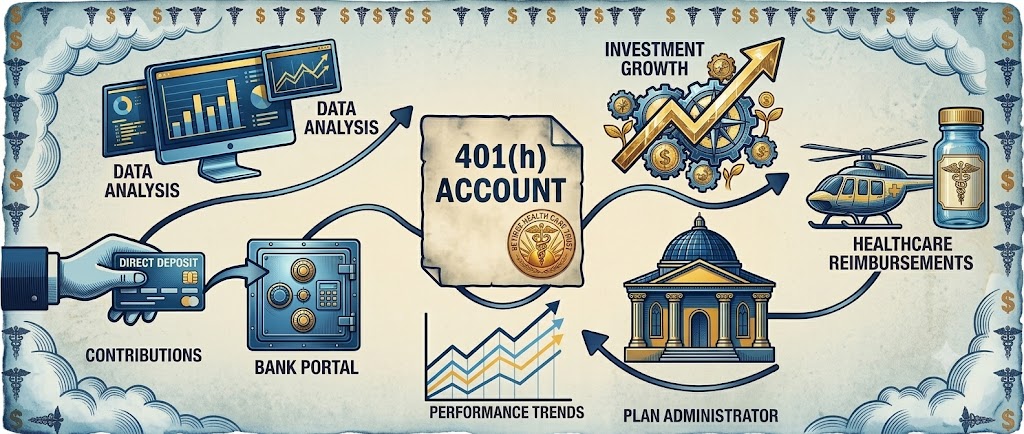
Integrating a 401(h) account into a Cash Balance Plan offers significant advantages, including tax-deductible contributions and tax-free medical reimbursements. These features enhance financial planning and provide robust asset protection for retirement medical expenses.
What Changes When You Add 401(h)?
Adding a 401(h) component to an existing or new cash balance plan introduces several layers of complexity and requires careful consideration. The integration fundamentally alters the actuarial valuation process, as the actuary must now project not only retirement benefits but also future healthcare costs for eligible retirees. This necessitates a more comprehensive data collection and assumption-setting process.
Contribution methodologies will also shift. While the cash balance plan targets a specific retirement benefit, the 401(h) requires contributions to fund the projected retiree medical liabilities. These contributions must be carefully coordinated to ensure the plan remains fully funded and complies with all IRS and ERISA regulations. The administrative workload expands significantly, encompassing separate accounting for the 401(h) funds, tracking eligible medical expenses, and ensuring ongoing compliance with specialized rules governing these accounts.
- **Actuarial Valuation:** Becomes more complex, incorporating medical cost projections.
- **Contribution Methodology:** Requires separate funding strategies for retirement and medical benefits.
- **Administrative Workload:** Increases due to separate accounting and compliance for 401(h) funds.
- **Incidental Benefit Limit:** Strict rules apply to ensure medical benefits are
The Incidental Benefit Limit
One of the most critical aspects when adding a 401(h) is adherence to the "incidental benefit" limit. This IRS rule dictates that the aggregate contributions for medical benefits must be subordinate to the contributions for retirement benefits. Generally, this means that the total contributions allocated to the 401(h) sub-account over the life of the plan cannot exceed 25% of the total contributions made to the entire plan since its inception. This limit is crucial to ensure the primary purpose of the plan remains providing retirement income, with medical benefits being a secondary, or incidental, feature. Constant monitoring by the plan actuary is essential to maintain compliance.
Key Design Considerations
Designing a cash balance plan with a 401(h) sub-account involves numerous strategic decisions. Advisors and plan sponsors must meticulously work through various questions to ensure the plan aligns with the employer's objectives and complies with all regulatory requirements. Key areas of focus include defining who will be eligible for these valuable retiree medical benefits. Will it extend to all employees, or a specific class? This impacts both cost and nondiscrimination testing.
Establishing a clear benefit formula or reimbursement framework is also paramount. Will the plan reimburse a fixed dollar amount for medical expenses, a percentage of premiums, or some other structure? The funding mechanics—how the medical benefit will be funded both at the plan's inception and on an ongoing basis—are crucial for long-term viability. Finally, the actuary will assess how the addition of the 401(h) affects the overall funding posture and solvency of the entire defined benefit plan.
- **Participant Eligibility:** Defining which employees will qualify for retiree medical benefits.
- **Benefit Formula:** Establishing the rules for how medical benefits will be provided or reimbursed.
- **Funding Mechanics:** Determining the initial and ongoing funding strategy for the 401(h) account.
- **Overall Plan Funding:** Analyzing the impact of the 401(h) on the plan's financial health and stability.
- **Nondiscrimination Testing:** Ensuring benefit provisions do not unduly favor highly compensated employees.
Documentation and Amendments
The legal documentation required for a cash balance plan with a 401(h) sub-account is extensive and highly specific. If an existing cash balance plan is being amended to add a 401(h), the amendment must incorporate all required 401(h) language as stipulated by the IRS and ERISA. This includes provisions for the establishment of a separate account exclusively for medical benefits, clear definitions of eligible benefits, identification of the participant class that will receive these benefits, detailed funding mechanics, and explicit rules governing any forfeitures.
Such a complex undertaking demands close collaboration between ERISA counsel and the plan actuary. The attorney ensures all legal language complies with regulatory requirements, while the actuary provides the necessary financial projections and confirms the plan's design is actuarily sound and sustainable. This collaborative approach minimizes interpretive ambiguities and safeguards against future compliance issues.
- **Separate Account Establishment:** Explicit language for segregating 401(h) funds.
- **Eligible Benefits:** Clear definition of covered medical expenses.
- **Participant Class:** Specifying who is eligible for the medical benefits.
- **Funding Mechanics:** Detailing contribution schedules and actuarial assumptions.
- **Forfeiture Rules:** Outlining how unspent funds are handled.
Compliance and Nondiscrimination
Beyond the incidental benefit rule, integrating a 401(h) account necessitates rigorous adherence to various nondiscrimination requirements. Similar to other qualified plans, the medical benefits provided through the 401(h) cannot disproportionately favor highly compensated employees (HCEs). This requires careful design and ongoing testing to ensure broad-based benefit availability.
The nondiscrimination analysis expands to encompass the retiree medical benefits, looking at factors such as eligibility, contributions, and benefits provided. The IRS provides specific guidance for 401(h) accounts to ensure equitable treatment across all employee groups. Regular monitoring and actuarial certifications are vital to demonstrate ongoing compliance and avoid potential disqualification of the entire plan, which could result in severe tax penalties.
- **Nondiscrimination Testing:** Required for eligibility, contributions, and benefits provided.
- **Highly Compensated Employees (HCEs):** Benefits cannot disproportionately favor HCEs.
- **Actuarial Certifications:** Essential for ongoing compliance verification.
- **Regular Monitoring:** Prevents issues and ensures equitable benefit distribution.
Who Benefits Most from a Cash Balance 401(h) Plan?
A cash balance plan with a 401(h) sub-account is a sophisticated financial tool best suited for specific demographics. Small business owners, particularly those with stable and high profits, can leverage this structure to significantly reduce their taxable income while building substantial retirement savings and future healthcare funding for themselves and their employees. Doctors, dentists, attorneys, and other high-income professionals operating their own practices often find this combination particularly appealing due to the substantial tax deductions and the ability to rapidly accumulate wealth in a tax-advantaged manner.
Companies looking to offer a robust and attractive benefits package to key executives or a select group of employees may also find the 401(h) integration beneficial. It demonstrates a commitment to employee well-being beyond traditional retirement, addressing a critical financial concern for many retirees: healthcare costs. However, due to the complexity and administrative costs, it's generally most cost-effective for businesses with several employees and the financial capacity to make consistent, significant contributions.
- **Small Business Owners:** Maximize tax deductions and personal retirement/healthcare savings.
- **High-Income Professionals:** Doctors, lawyers, and consultants benefit from significant tax advantages.
- **Key Executive Retention:** Offers a highly attractive benefit package for top talent.
- **Wealth Accumulation:** Rapid, tax-advantaged growth for retirement and medical needs.
Frequently asked questions
Availability, tax treatment, and plan design depend on the facts and circumstances of the employer, plan document, participant group, and applicable law. 401h.com provides general educational information only — not tax, legal, actuarial, investment, or ERISA advice. Consult qualified tax, legal, actuarial, and plan professionals.
401h.com Editorial
401h.com
The 401h.com editorial team publishes plain-English explainers on 401(h) retiree medical benefit plans. Educational only — not tax, legal, actuarial, investment, or ERISA advice.
Related articles
How 401(h) Plans Can Help Fund Retiree Medical Expenses
Pre-funding retiree medical benefits brings discipline to one of retirement planning's biggest unknowns. Here's how 401(h) sub-accounts contribute to that picture.
401(h) Plan Rules: What Business Owners and Advisors Need to Know
401(h) accounts are powerful but rule-driven. Five buckets — documentation, accounting, incidental benefit, nondiscrimination, and funding — determine whether the structure stands up.
Defined Benefit Plan + 401(h): How the Strategy Works
Defined benefit plans paired with 401(h) sub-accounts can help employers formalize and pre-fund a defined stream of retiree medical benefits.