
401(h) Plan Design Checklist for Advisors
Advisors guiding clients through the complexities of 401(h) plans need a robust framework. This checklist helps ensure proper documentation, thoughtful design, and diligent administration of these valuable retiree health benefit sub-accounts.
Contents
Understanding the 401(h) Advantage
A 401(h) account is a unique subset of a qualified defined benefit (DB) or cash balance (CB) pension plan, specifically designed to provide tax-advantaged funding for retiree health benefits. For small business owners, doctors, and high-income earners, this structure offers a compelling way to accumulate funds to cover future medical expenses for themselves and their employees in retirement. Unlike individual health savings accounts (HSAs) or traditional post-retirement benefit plans, 401(h) plans are funded through employer contributions to the underlying pension plan, offering significant tax deductibility and tax-deferred growth.
The real power of a 401(h) lies in its ability to combine with a primary pension plan, leveraging the same trust and administrative infrastructure. This integration can create a highly efficient and compliant mechanism for pre-funding healthcare costs, which are a growing concern for retirees. Advisors play a critical role in ensuring these plans are structured correctly from the outset and maintained diligently over time to realize their full potential.
Documentation: The Foundation of Compliance
The bedrock of any successful 401(h) plan is thorough and accurate documentation. Without explicit, complete, and current plan documents, the entire structure is vulnerable to scrutiny and potential disqualification. This first phase of the 401(h) checklist focuses on confirming that all legal and regulatory requirements are met on paper, providing a clear roadmap for the plan's operation.
It's not enough for the underlying qualified plan to simply exist; its provisions must explicitly address the 401(h) sub-account. Advisors must verify that these documents clearly define who is eligible, what benefits are covered, and how the plan will be funded and administered. Any ambiguities can lead to significant issues down the line.
- Plan amendment establishing the 401(h) sub-account.
- Eligible participant class clearly defined.
- Qualifying retiree medical benefits defined.
- Funding, forfeiture, and reversion mechanics addressed.
- Summary Plan Description updated.
Design: Crafting a Sustainable Benefit
Once the foundational documentation is in place, the next crucial step is designing the 401(h) plan to meet the client's objectives while adhering to strict regulatory guidelines. This involves making a series of structural choices that will dictate the plan's operation and benefit delivery. These decisions should precede any financial modeling to ensure the design aligns with strategic goals and compliance requirements.
Key considerations during the design phase include defining the scope of benefits, establishing eligibility criteria, and ensuring the plan doesn't inadvertently discriminate in favor of highly compensated employees. A well-designed plan strikes a balance between providing meaningful retiree health benefits and maintaining long-term financial viability and regulatory compliance.
- Which retirees are covered, and on what eligibility terms?
- Which medical benefits or premium categories are in scope?
- How are spouses and dependents treated?
- How does the design satisfy nondiscrimination?
- What are the contribution limits and how are they managed over time?
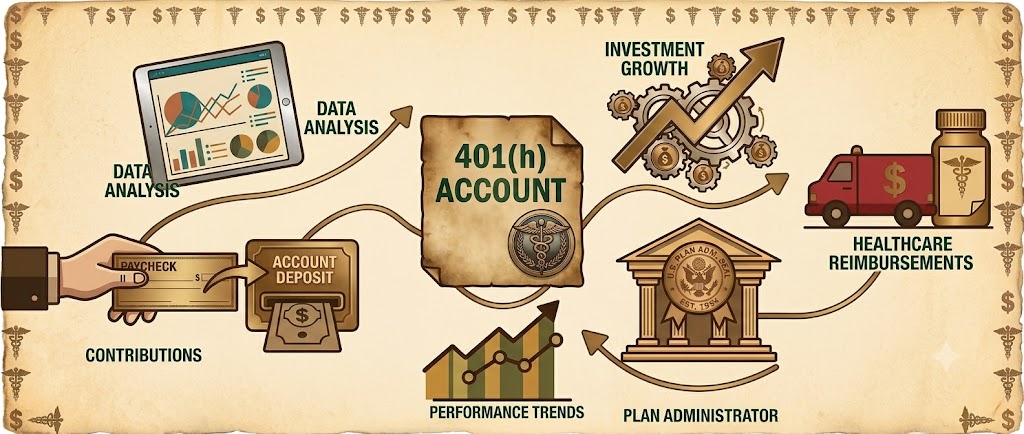
This visual highlights the six essential components for advisors to consider when designing a sustainable 401(h) plan. Understanding each element, from funding to compliance, is crucial for a robust retiree-medical-benefit structure.
Funding: Actuarial Precision and Ongoing Management
Funding a 401(h) account is a complex, actuarial exercise that requires ongoing management rather than a one-time deposit. Contributions to the 401(h) portion of a qualified plan must be
Incidental Benefit Rule: A Critical Constraint
A cornerstone of 401(h) compliance is the 'incidental benefit rule,' which dictates that benefits provided under a 401(h) account must be subordinate to the retirement benefits provided by the main pension plan. This is not merely an advisory guideline but a strict IRS requirement that must be continuously monitored and demonstrated. Generally, contributions to the 401(h) account, when added to life insurance protection provided under the plan, cannot exceed a certain percentage (e.g., typically 25%) of the employer's cumulative contributions to the plan (excluding those for past service credit). Exceeding this limit can result in serious tax consequences and potential plan disqualification.
Advisors must establish rigorous methodologies to track contributions and benefits to ensure ongoing compliance with this rule. This requires careful coordination with actuaries and regular reviews of funding levels and benefit disbursements. Proactive monitoring helps identify potential breaches before they occur, allowing for timely adjustments to prevent costly penalties.
- Contributions to 401(h) (and life insurance, if applicable) must not exceed a specific percentage of total employer contributions to the *primary* pension plan.
- This calculation is cumulative and must be monitored annually.
- Breaching the incidental benefit rule can lead to severe tax penalties and plan disqualification.
Administration: Sustaining the Plan's Integrity
Establishing a 401(h) plan is only the beginning; its long-term success hinges on robust and consistent administration. This involves setting clear procedures and adhering to a regular cadence of reviews and reporting. Proper administration ensures that the plan operates according to its design, remains compliant with ever-evolving regulations, and effectively delivers benefits to retirees.
From annual valuations to managing participant communications, the administrative burden can be substantial. Advisors must help clients establish a structured approach, often working with a team of service providers, to handle these tasks efficiently and accurately. A well-oiled administrative process minimizes risks and maximizes the plan's value.
- Annual valuation, Form 5500, and operational review.
- Claims procedure and substantiation standards.
- Vendor list with documented responsibilities.
- Restatement calendar.
- Participant communications cycle.
The Advisor's Role: Beyond the Checklist
While this checklist provides a vital framework, the advisor's role in 401(h) plans extends far beyond simply ticking boxes. It involves strategic guidance, proactive problem-solving, and serving as a knowledgeable liaison between the client, actuaries, plan administrators, and legal counsel. Advisors help clients understand the intricate interplay of tax law, ERISA regulations, and actuarial science that underpins these powerful benefit structures.
Furthermore, advisors are crucial in helping clients integrate the 401(h) plan into their broader financial and succession planning. This includes evaluating the ongoing financial commitment, assessing demographic changes, and ensuring the plan remains aligned with the client's long-term business and personal objectives. By taking a holistic approach, advisors can unlock the full potential of 401(h) plans for their high-net-worth clients.
Frequently asked questions
Availability, tax treatment, and plan design depend on the facts and circumstances of the employer, plan document, participant group, and applicable law. 401h.com provides general educational information only — not tax, legal, actuarial, investment, or ERISA advice. Consult qualified tax, legal, actuarial, and plan professionals.
401h.com Editorial
401h.com
The 401h.com editorial team publishes plain-English explainers on 401(h) retiree medical benefit plans. Educational only — not tax, legal, actuarial, investment, or ERISA advice.
Related articles
401(h) Plan Rules: What Business Owners and Advisors Need to Know
401(h) accounts are powerful but rule-driven. Five buckets — documentation, accounting, incidental benefit, nondiscrimination, and funding — determine whether the structure stands up.
Common 401(h) Plan Mistakes to Avoid [Tips + Tricks]
A 401(h) plan can be a powerful tool for providing tax-advantaged retiree health benefits, but many common mistakes can undermine its effectiveness. Learn what to avoid.
401(h) Plans for CPAs: Questions to Ask Before Recommending One
For CPAs advising high-income clients, evaluating a 401(h) plan requires a thorough review. Asking the right questions upfront can ensure the recommendation aligns with the client's financial goals and regulatory compliance.